
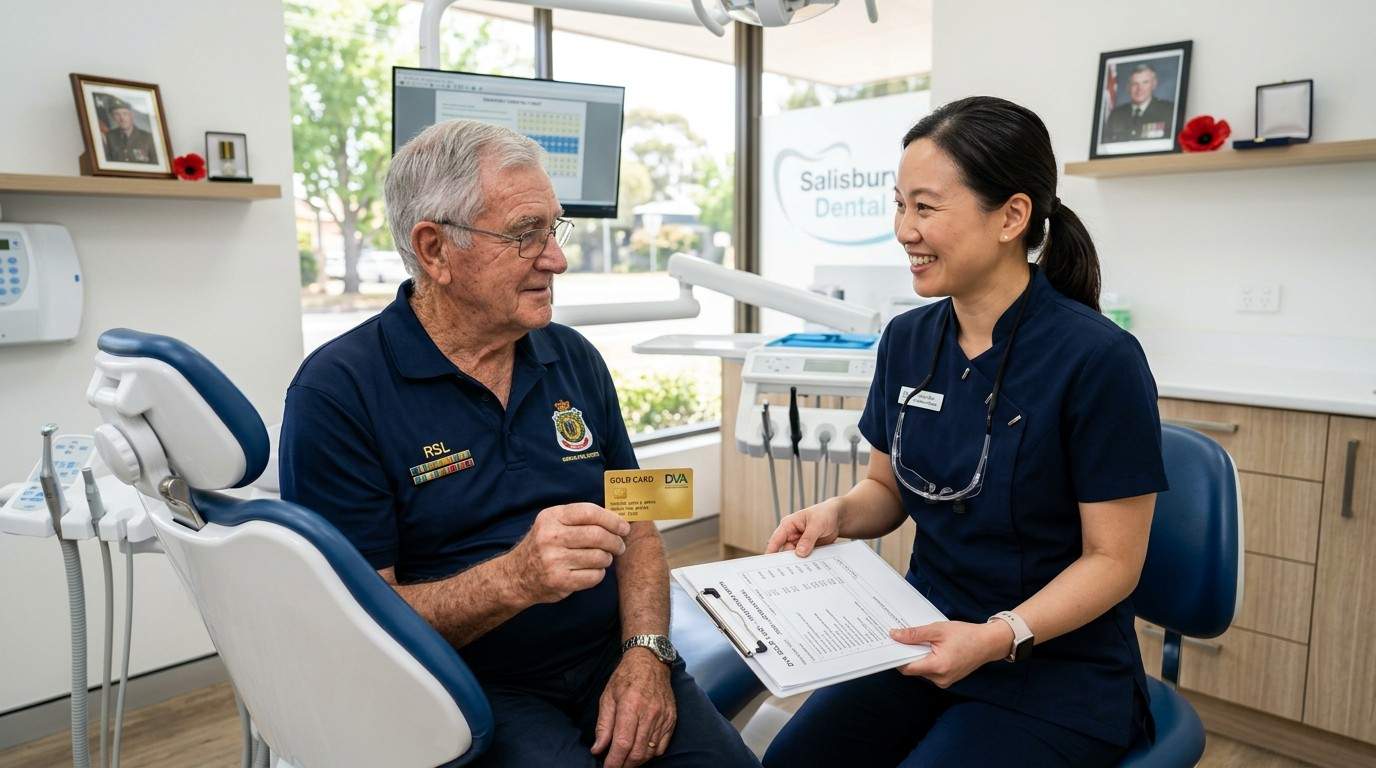
If you or a family member holds a DVA Gold Card, you want to know exactly what dental care it covers. Clear information helps you plan treatment and avoid surprise costs.
The DVA Gold Card gives eligible veterans access to a wide range of healthcare, including dental services. However, the details can feel confusing, especially with fee schedules and limits that update regularly. This guide explains, in plain language, what dental services are covered under a DVA Gold Card and how you can use these benefits with a local provider in Salisbury, such as Parabanks Dental, which offers DVA dental benefits in Salisbury.
What is the DVA Gold Card and who usually has it? A quick overview of veteran eligibility, dependants, and how dental care fits into the wider DVA health benefits.
A DVA Gold Card is issued to eligible veterans and, in some cases, their dependants, to cover clinically required health care for all conditions. It can be held by former service men and women, war widows and widowers, and some dependants who meet set criteria. The card covers medical services, allied health, hospital care, and dental treatment under specific schedules and rules. Dental care sits within this framework as one of the health services funded by DVA, delivered by private providers who are registered with DVA and agree to its fee schedule.
How DVA dental funding works in 2026: Schedules A, B, and C, biennial monetary limits, and the latest changes to fees and caps.
DVA uses a structured fee schedule for dental services, grouped into Schedules A, B, and C. Schedule A generally covers routine and preventive care, Schedule B covers more complex services with specific limits, and Schedule C is tied to a higher biennial monetary limit for major work. From 1 January 2026, updated fee schedules list the maximum amounts DVA will pay for each item, and a biennial limit of around $5,980 applies to certain major treatments under Schedule C. These updates mean more support for eligible veterans but still require providers to bill in line with DVA rules.
General and preventive dental services covered for DVA Gold Card holders (check-ups, X-rays, cleans, fluoride, and gum disease care).
DVA Gold Card holders are generally covered for core preventive care when it is clinically necessary. This includes dental examinations, X‑rays, scale and clean appointments, fluoride applications, and periodontal (gum disease) treatment. The aim is to maintain oral health and prevent more serious problems where possible. When you attend a local practice in Salisbury that accepts DVA, such as a clinic providing general dentistry for Salisbury patients, the dentist can plan these routine services within the DVA fee schedule so there is usually no gap if they follow the approved fees.
Restorative and major dental services under DVA: fillings, root canal treatment, crowns, bridges, and dentures, including key limits and conditions.
Beyond check-ups, DVA covers many restorative and prosthetic treatments where they are clinically justified. This can include fillings, root canal treatment, extractions, crowns, bridges, partial and full dentures, and relines or repairs of existing dentures. However, some of these items fall under Schedules B and C, which come with time limits, frequency limits, and monetary caps. For example, there may be restrictions on how often you can receive new dentures or multiple crowns within a set period. A Salisbury provider familiar with DVA, such as one offering crowns and bridges in Salisbury or dentures for DVA patients, can advise how these limits apply to your treatment plan.
Emergency dental treatment and dental injuries: what DVA Gold Card holders can expect in urgent situations.
If you experience sudden toothache, infection, or dental trauma, your DVA Gold Card can cover emergency dental care when a DVA‑registered dentist deems it clinically necessary. Emergency items may include urgent examinations, X‑rays, dressings, extractions, or temporary restorations to relieve pain and stabilise the situation. In many cases, the practice can see you promptly and then plan any follow‑up work under the normal schedule rules. For veterans near Salisbury, seeing an emergency dentist in Salisbury who understands DVA billing makes it easier to get urgent help without worrying about paperwork on the day.
Schedule C and the biennial monetary limit: what it covers, the current $5,980.30 cap for 2026–2027, and how this affects complex dental treatment.
Schedule C covers more extensive dental treatment that can involve higher costs, such as multiple crowns, complex restorative work, or larger prosthetic cases. DVA sets a biennial monetary limit for this schedule, which is around $5,980.30 for the 2026–2027 period. This cap applies to eligible Schedule C items over two calendar years. Once the limit is reached, further treatment may require special approval or different funding arrangements. Understanding this limit helps you and your dentist decide how to stage major work, such as a sequence of crowns or full denture replacement, within what DVA will pay.
Services that are restricted or need prior approval: extractions, multiple crowns, implants, and treatment above time or quantity limits.
Some services are covered but subject to prior approval or strict rules. This may include multiple extractions, extensive crown or bridge work, and certain prosthetic treatments that exceed standard limits. Dental implants are more tightly controlled and often require strong clinical justification, with approval being case‑by‑case. Providers must follow DVA billing and compliance requirements, including seeking approval when treatment falls outside usual item limits. A practice that understands these rules will explain them to you first so you know where approvals are needed before major dental work proceeds.
What is generally not covered under the DVA dental schedule, and where Gold Card holders might still face out-of-pocket costs.
While DVA Gold Card benefits are generous, they are not unlimited. Cosmetic procedures without clinical need, such as whitening for appearance alone, are usually not covered. If a dentist charges more than the DVA fee for an item, the practice cannot simply bill the extra to DVA, and you may face a gap if you agree to that higher fee. Some items outside the schedule, or treatment started without following DVA rules, can also fall outside cover. It is important to discuss fees and item numbers before treatment so you understand any possible out-of-pocket costs.
How to use your DVA Gold Card for dental care at a local Salisbury dentist: choosing a DVA-registered provider, bringing your card, and what happens at the appointment.
To use your DVA Gold Card, you must attend a dentist who is registered with DVA and agrees to bill under the DVA dental schedule. When you book, mention that you are a DVA Gold Card holder and bring the card to your appointment. The dentist will assess your needs, plan treatment, and bill DVA directly for covered services, as long as they follow the schedule and any approval rules. A clinic like Parabanks Dental, which clearly explains its DVA dental benefits for Salisbury veterans, can guide you through what is covered and how they handle claims.
Combining DVA dental benefits with other supports in Salisbury, such as the Child Dental Benefits Schedule for grandchildren and general affordable care options.
Many veteran families also care for children or grandchildren, so you may want to combine DVA benefits with other supports. For younger family members, the Child Dental Benefits Schedule in Salisbury can help fund preventive care and basic treatment. For other relatives, practices may offer affordable dental care options in Salisbury SA and payment plans for treatment not covered by DVA. In this way, one family dentist in the Parabanks area can support both DVA card holders and the wider family with different funding streams.